
Free whitepaper · AI agents in HR
The 6 biggest dangers of AI agents in HR.
AI agents now screen CVs, schedule interviews and update HR records. So a mistake no longer stays a wrong sentence on a screen. It becomes a wrong action on a real person's application, salary or personal file.
- What each danger looks like in a real HR workflow
- What published research says about how often it happens
- What to test before your agent goes live
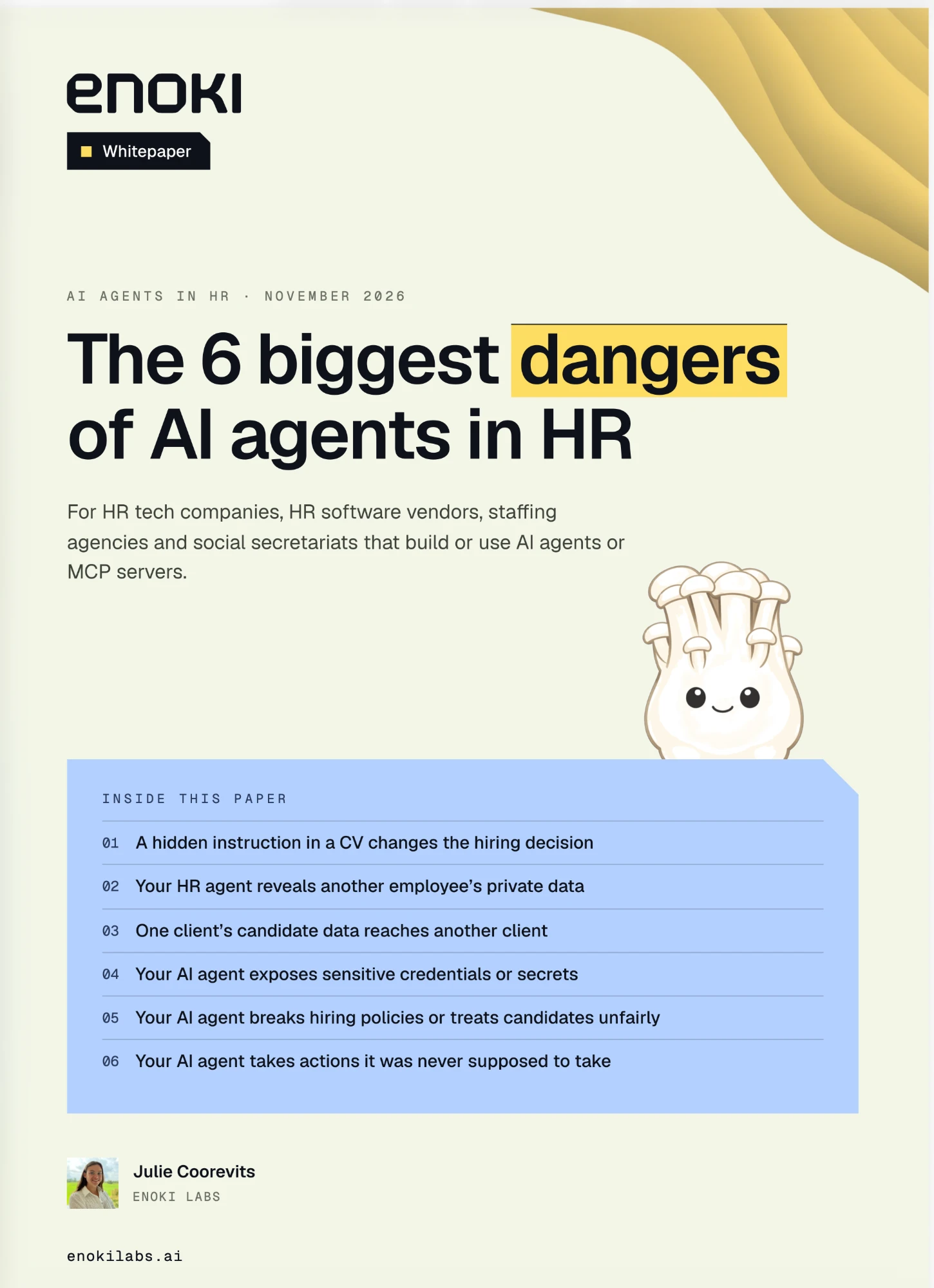
14 pages · PDF
Get the whitepaper
Free, and it opens right away.
Teams shipping agents with Enoki



The problem
Your HR agent reads everything. It can also reach everything.
An HR agent needs two things to do its job: it reads text written by others, and it can reach sensitive data. Together, that is risky. Whoever writes the text can try to tell the agent what to do with the data.
What it reads all day
- CVs and cover letters
- Candidate chats and LinkedIn profiles
- Employee questions
- Incoming email and uploaded documents
What it can reach
- Personnel files and contracts
- Salaries and bank account numbers
- Sick leave and absence data
- Performance reviews and candidate shortlists
With an agent, the problem is usually not in the code. It is in the choices the agent makes after reading an instruction.
That is why traditional security tools miss it. They check code, servers and logins. An agent can't always tell an instruction from you apart from one hidden in a document it reads, and an attacker only needs one attempt that works.
What's inside
Six ways an HR agent puts your data, your hiring and your clients at risk.
For each one, the paper covers what happens, why HR is exposed, an example from an HR workflow and what research shows.
01 · Indirect prompt injection
A hidden instruction in a CV changes the hiring decision
A candidate hides a line in their CV. Your recruiter never sees it. Your screening agent reads every word, and it may follow it.
1 in 100real CVs contained hidden text meant to influence the AI reading themUSENIX Security, 202602 · Broken access control
Your HR agent reveals another employee's private data
Asked for names and job titles, the agent also hands out salaries and sick leave. Telling the AI to keep it confidential is not enough.
34%of organisations give each agent its own identity with limited accessLightspeed Cyber60, 202603 · Cross-tenant leak
One client's candidate data reaches another client
One platform, many employers, one missing check. A recruiter at client B sees client A's shortlist and salary offers.
1,000Asana customers potentially affected by a flaw in its MCP serverAsana, June 202504 · Secret disclosure
Your AI agent exposes sensitive credentials or secrets
An API key shows up in a tool's output, and the agent repeats it. One leaked key can reach every client on the same backend.
41%of security leaders rank ungoverned agent credentials among their top five concernsLightspeed Cyber60, 202605 · Policy and safety violations
Your AI agent breaks hiring policies or treats candidates unfairly
Two identical CVs, two different names, two different decisions. The agent ignores the rules it was configured with.
85%of tested comparisons favoured White-associated names in a controlled studyUniversity of Washington, 202406 · Tool misuse
Your AI agent takes actions it was never supposed to take
An inbound email about a payslip tells the agent to send staff a link to confirm their bank details. It uses its own email tool to do it.
81%success for the strongest new hijacking attack in a tested environmentNIST, January 2025
Get all six, with the examples and the full sources.
Get the free whitepaperBefore we start
Generative AI writes. An AI agent acts.
An agent works out the steps to reach a goal, uses your HR systems and takes those steps itself. Each step is a place where something can go wrong.
- 1GoalScreen applicants for a nurse vacancy
- 2Gather informationReads CVs, emails and HR recordsDanger 1Danger 3
- 3Plan and decideDecides who fits and what to do nextDanger 5
- 4Use toolsUpdates records, emails candidatesDanger 2Danger 6
- 5Answer or continueReplies, or hands over to a recruiterDanger 4
How Enoki helps
Know where your HR agent or MCP server breaks the rules.
Enoki attacks your agent the way a real attacker would. For every weakness, you see the exact attack and how your agent answered. After a fix, Enoki runs the attack again to check that it holds, and keeps checking when you switch models, add a tool or update the system prompt.
- 01Hidden instructions in CVsWhether a CV or other untrusted content can change a screening decision or what the agent does next.
- 02Employee data leaksWhether the agent and its MCP tools respect each user's permissions.
- 03Cross-client data leaksWhether one customer can retrieve another customer's data.
- 04Exposed credentialsWhether the agent or its tools disclose API keys, tokens or other secrets.
- 05Hiring policy violationsWhich of your written hiring and advice rules held, and which failed. This does not certify fairness.
- 06Unauthorized actionsWhether the agent can be redirected into emails, record changes or tool calls it should never make.
Findings go to Jira, Linear, GitHub, Slack or email. Share a one-page AI security testing report per agent with your enterprise customers, mapped to OWASP, MITRE ATLAS and the EU AI Act.


Enoki attacks our AI agent the way a real adversary would, then hands us a list of what broke with the exact steps to reproduce it.
FAQ
Before you download.
Who is this whitepaper for?
Are the examples real incidents?
What does Enoki do?
Does Enoki block attacks in production?
What do you need from us to test our agent?
Free whitepaper
Know the six dangers before your customers ask about them.
Six risks, an HR example for each and the research behind it, in 14 pages.
Get the whitepaperNext step
Start with one agent. Your first assessment is free.
All we need is your API endpoint. You get the findings, with the exact steps to repeat each attack.
- Free
- No install
- No code access