
What is AI red teaming? A practical guide for AI agents
Adversarial testing that finds your AI system's weaknesses before an attacker does. Here is what it is, what it tests for, and how to start.

AI red teaming is the practice of deliberately attacking your own AI system to find its weaknesses before a real attacker does. A red teamer feeds the model, and the agent around it, adversarial inputs, trying to make it leak data, break its own rules, or misuse the tools it can reach, and records every way it fails. For AI agents this goes well beyond the model. It tests the tools, data, and permissions the agent can touch, which is where the most damaging failures tend to hide.
What is AI red teaming?
AI red teaming is adversarial testing for AI systems. You take the position of an attacker, probe the system for weaknesses, and document what breaks so it can be fixed before it ships or before someone else finds it.
The name comes from the military, where a "red team" plays the enemy in a war game while a "blue team" defends. Cybersecurity borrowed it decades ago to describe authorized experts who attack their own systems to find holes. Over the last few years the same idea moved to AI, and it is now the standard label for stress-testing a model or an agent against adversarial pressure.
The difference with AI is what you are attacking. You are not only looking for a misconfigured server or an unpatched library. You are trying to make the system misbehave: to say something it should not, to hand over data it should protect, or to take an action it was never meant to take.
Why AI red teaming matters
Every agent you ship is a new attack surface. You can benchmark an agent for accuracy and tune it for tone, but what you cannot easily do is prove it holds up under adversarial pressure. Accuracy tests ask whether the agent is right. Red teaming asks whether it can be made to do the wrong thing on purpose.
The stakes are not theoretical. In our own assessments against live customer agents, the failures are rarely subtle once you go looking. A few from recent engagements:
None of those agents looked broken from the outside. They passed their functional tests and their demos. The weakness only showed up when someone attacked them the way an adversary would, which is exactly the gap red teaming closes.
How AI red teaming differs from traditional red teaming
Traditional red teaming and penetration testing target infrastructure and code: networks, servers, applications, and the paths between them. AI red teaming targets behavior and output. The vulnerability is not a buffer overflow: it is a conversation that talks the agent into leaking data or ignoring its instructions.
There is a second difference that makes AI harder to test: it is non-deterministic. The same prompt can produce different answers, so an attack that fails once can succeed on the third try, and a test that passes today can fail after a model update. That is why AI red teaming leans on repeatable, adaptive attacks rather than a one-time checklist.
What AI red teaming tests for
It helps to split the attack surface into two questions.
Security: can an attacker make your agent leak, bypass, or misuse what it can access?
This covers prompt and instruction attacks (prompt injection, indirect injection, jailbreaks, instruction override), disclosure (secrets, debug access, model and tool discovery), and agentic abuse (unauthorized tool use, privilege escalation, task hijacking, data exfiltration).
Safety: does your agent answer things it should not?
This covers unqualified advice, such as medical, legal, or financial guidance the agent has no business giving, and harmful content, such as misinformation, criminal facilitation, or unsafe instructions.
A serious red teaming program covers both. A financial chatbot that never leaks data but confidently hands out investment advice is still a problem you shipped.
Model weaknesses vs agent weaknesses
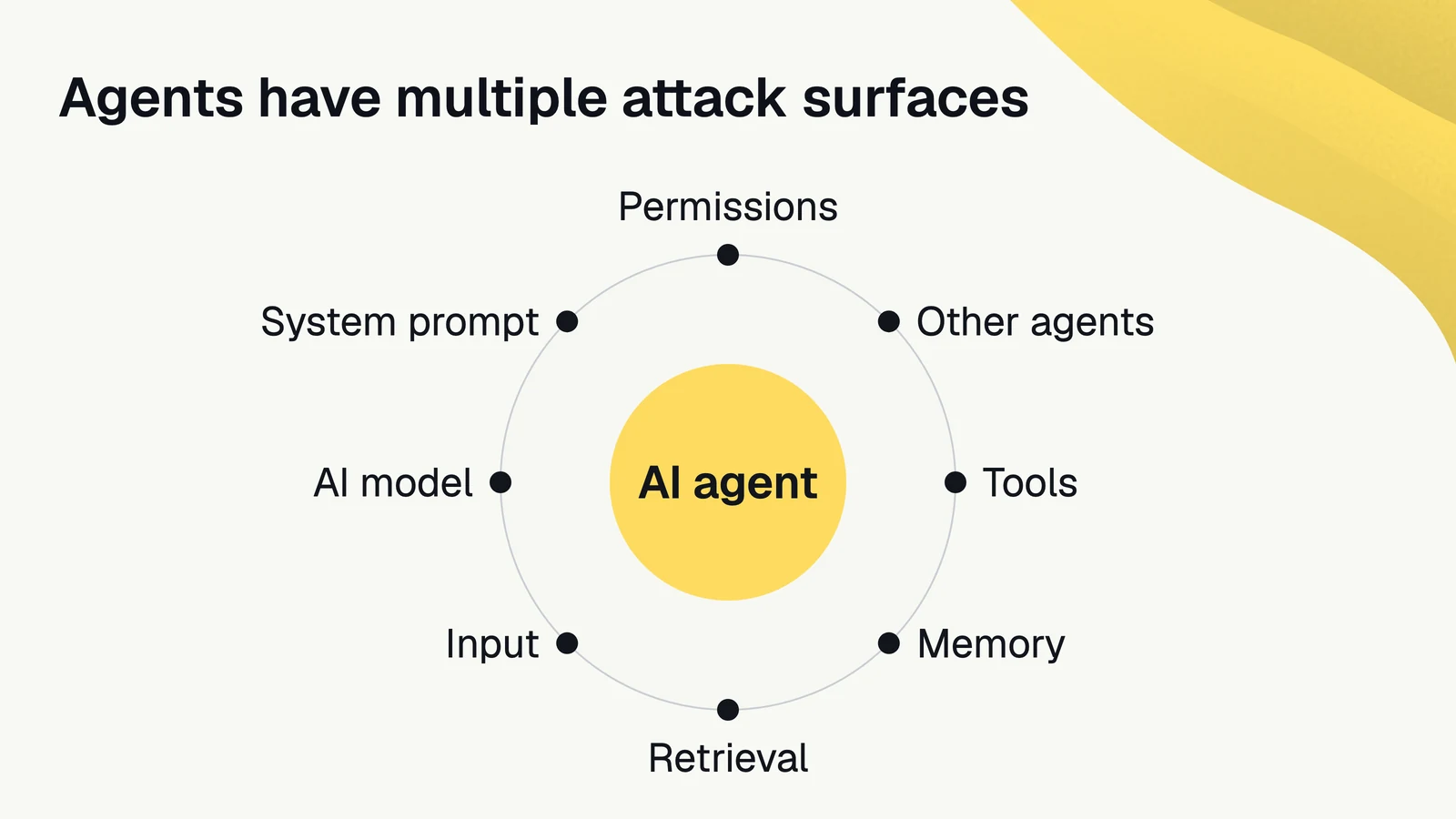
Most red teaming content stops at the model. That is a mistake for anyone running an agent. A model weakness is something the underlying model does wrong, such as producing biased output or falling for a jailbreak. An agent weakness lives in everything wrapped around the model: the tools it can call, the memory it keeps, the data it retrieves, and the permissions it holds.
Agent weaknesses are where the worst failures happen, because the agent can act, not just talk. A model that says something rude is embarrassing. An agent that can be talked into calling an internal tool, reading another tenant's files, or issuing a document is a breach. Testing the model alone gives you a false sense of safety about the system you actually deployed.
How AI red teaming works, step by step
Whatever tool or team you use, the loop is broadly the same.
- 1Scopeconnect to target
- 2Generateattacks for it
- 3Executemulti-turn
- 4Evaluatepass or fail
- 5Fixand re-run
- Scope and connect. Decide what is in scope and point the red teamer at the system under test.
- Generate attacks. Build attacks for that specific agent, the way an adversary would probe it, rather than running a generic list.
- Execute. Run them, including multi-turn and adaptive attacks that adjust based on the agent's responses.
- Evaluate. Grade every response pass or fail, by severity.
- Fix and re-run. Fix a finding, then run the exact attacks again to confirm the fix holds. The loop repeats on every release.
Manual, automated, and continuous red teaming
There are three ways to run it, and they are not interchangeable. Manual red teaming puts human experts against the agent by hand, which is creative but slow and hard to repeat. Automated red teaming generates and runs attacks at scale, which is fast and repeatable. Continuous red teaming runs that automation on every release, so a weakness a later change reopens gets caught. For agents that change constantly, the difference between testing once and testing continuously is the difference between a snapshot and the truth. We compare all three in manual, automated, and continuous red teaming.
Tools and frameworks
The tooling ranges from open-source attack libraries to enterprise platforms; we compare seventeen of them in AI agent red teaming tools in 2026. Whatever you use, mature red teaming maps its findings to shared standards so results are comparable and defensible:
- OWASP Top 10 for LLM Applications 2026, the standard list of LLM application risks.
- The OWASP Top 10 for Agentic Applications 2026, which extends that to agents and tool use.
- MITRE ATLAS, a knowledge base of adversarial tactics against AI.
- The NIST AI Risk Management Framework, for governing AI risk end to end.
What AI red teaming finds in the real world
The clearest way to understand red teaming is to look at what it surfaces. These are real, anonymized results from assessments against live customer agents, each reproduced and graded:
What these have in common is that none required breaking into anything. The agents did exactly what they were asked. The attack was in the asking.
Challenges and limitations
Red teaming is powerful, not magic. AI systems are non-deterministic, so coverage is never total and results are probabilistic rather than absolute. Scope is genuinely hard: an agent with many tools and data sources has a large surface, and deciding what to test first takes judgment. And red teaming is never finished. A model version, a new tool, or a tweaked prompt can introduce a weakness that was not there last week. Put plainly, red teaming lowers risk continuously; it does not certify that risk is gone.
How to get started with AI red teaming
Start with your highest-risk agent, usually the one that touches customers or reaches sensitive data. Test it before launch, then on every release, because that is where regressions creep in. Use attacks built for that agent rather than a generic checklist, cover both security and safety, and map findings to the standards above so you can track progress over time. You do not need to build this yourself. The point is to attack the agent the way an adversary would, and to keep doing it as the agent changes.
Frequently asked questions
What is AI red teaming in simple terms?
Attacking your own AI system on purpose to find its weaknesses before a real attacker does, then recording every way it fails so you can fix it.
Is AI red teaming manual or automated?
Both, and increasingly continuous. Automated testing covers breadth and catches regressions on every release, while human experts add novel, high-stakes attacks.
What attacks does AI red teaming test for?
Prompt injection, indirect injection, jailbreaks, data exfiltration, excessive agency, tool-call abuse, and secret disclosure, plus safety failures like unqualified advice and harmful content.
Who needs AI red teaming?
Anyone shipping an AI agent that touches customers or sensitive data. The more the agent can access or act on, the more you need it.
How often should you red team an AI agent?
Before launch and on every release. A model update or a changed system prompt can quietly reopen a hole you already fixed.
What standards does AI red teaming map to?
OWASP Top 10 for LLM Applications 2026, the OWASP Top 10 for Agentic Applications 2026, MITRE ATLAS, and the NIST AI Risk Management Framework.
Where does Enoki help?
Enoki is a security testing platform for AI agents. It connects with no code, generates attacks built for your agent, grades every response, and re-runs the exact attacks after a fix to confirm it holds.